
Reviewed · TUK-TUK TOURS
Porto Half Day Private Tuk Tuk Tour
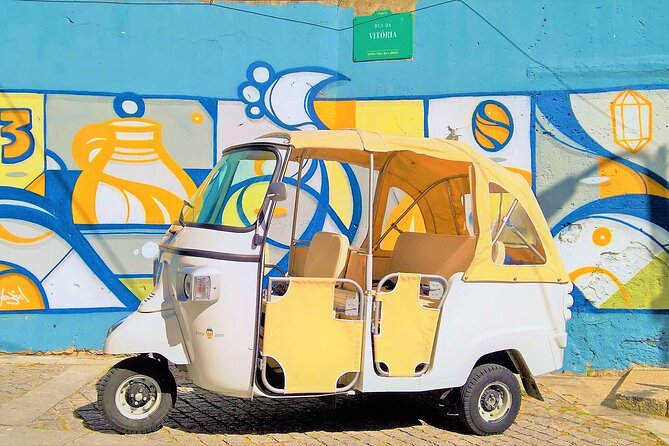
Porto by tuk tuk keeps things practical. You get private wheels for a 3.5-hour loop, with a licensed driver/guide and live English commentary that helps you connect the dots fast. Tours often turn out especially fun when your guide is someone like Ana or Fabio, who know how to explain Porto without turning it into a lecture.
What I like most is the combination of speed and local detail. In one half day you can see major landmarks, then hop into lesser-visited corners the car can’t reach. And because it’s private, the driver can usually adjust the stops to match your pace and interests instead of forcing a rigid checklist.
The main drawback to plan around is timing pressure. Porto traffic, narrow streets, and occasional delays can squeeze the schedule, and then some stops (and the included wine tasting) may feel rushed or shortened.
In This Review
- Key things to know before you go
- A half-day private tuk tuk in Porto, and why it works
- Starting point and the tuk tuk setup you should expect
- São João area and the Romanesque wall: Porto’s layers in fast form
- Mosteiro da Serra do Pilar: the UNESCO terrace that makes the river click
- Dom Luís I bridge: ferried by Metro, still the star
- Igreja de São Francisco and the baroque gold effect
- Palácio da Bolsa and Arabian Room: Porto’s moneyed side
- Ferreira Borges square and the Infante D. Henrique monument
- Jardins do Palácio de Cristal: your break from stone and stairs
- Mercado Ferreira Borges and Alfândega Nova: iron architecture and reuse
- Carmo and Clérigos: two tower-and-church moments that define the skyline
- Cordoaria Garden, the old prison, and Camilo’s shadow
- Livraria Lello: the red staircase and the decision to pay
- Wine tasting and pacing: how to make the half day feel worth it
- Should you book this Porto half-day private tuk tuk tour?
Key things to know before you go
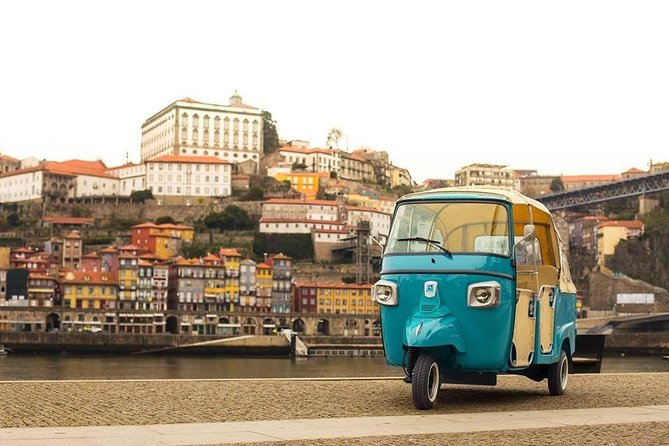
- Porto and Gaia views without the steep slog: the ride is made for hills and short hops between viewpoints.
- UNESCO time at Mosteiro da Serra do Pilar: circular church plan, 36 Ionic columns in the cloister, and a terrace view over both riverbanks.
- One big infrastructure star, Ponte Dom Luís I: a forged-iron bridge with overlapping decks, including where the Metro runs today.
- Two “church-with-wow” stops: gilded baroque interior at Igreja de São Francisco and rococo carvings at Igreja do Carmo.
- Classic photo stops built into the route: Torre dos Clérigos, the Livraria Lello area, and the old prison now used for photography.
- Wine tasting is included, but ask early: if your schedule runs late, you’ll want to confirm when it happens.
A half-day private tuk tuk in Porto, and why it works
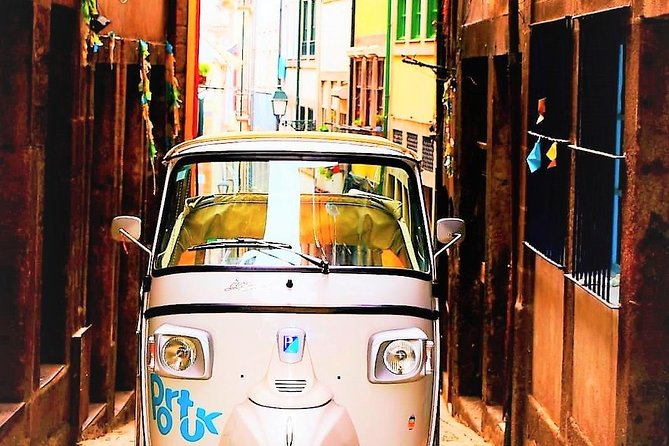
This tour is built for one of Porto’s biggest challenges, getting around. The city is famously hilly, and many key sights cluster in the older center and along the river slopes. A tuk tuk is a smart middle ground: it can squeeze through tight streets and still feel like you’re sightseeing, not sprinting on foot.
You also get onboard live commentary in English, which changes the value math. Random photos are fine, but Porto’s layers are what you really want: Romanesque remnants, theater history, fortified church terraces, and the way the river shapes everything.
And yes, it’s private in the sense that it should be just your group. If you have a set priority, you can ask to bias the route. That flexibility is a big reason people book a half day instead of trying to stitch together a full DIY day.
More tuk-tuk loops through the old streets:
- Porto: Guided Tour by Tuk-Tuk & Optional Douro River Cruise★ 4.5 · 5,980 reviews
- Discover Porto’s Highlights on a 2-Hour Private Electric Tuk Tuk★ 4.5 · 1,860 reviews
- Porto: Guided Tuk Tuk Tour★ 4.6 · 1,390 reviews
- Historic Porto by Private Electric Tuk Tuk to Top Landmarks★ 4.5 · 735 reviews
Starting point and the tuk tuk setup you should expect
The tour meets at R. de Augusto Rosa 180, 4000-528 Porto and ends back there. That matters because it reduces the “where do we go now?” friction that can eat up time in a city like Porto.
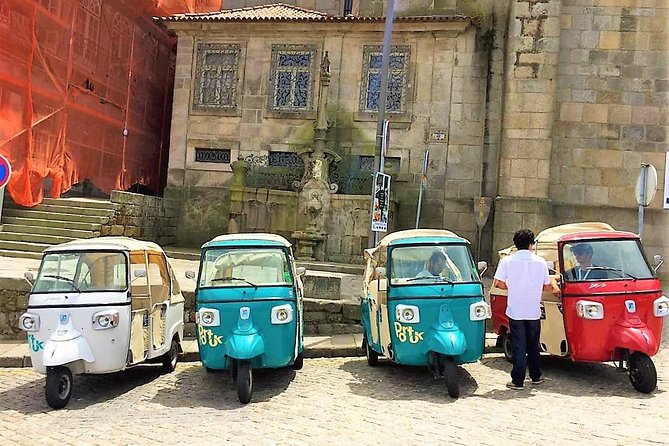
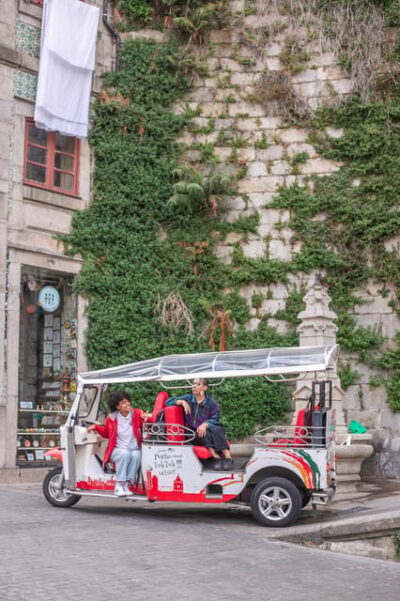
Each tuk tuk can carry 2, 3, or 4 adults (average height, up to 75 kg each). For larger groups, you may ride in multiple tuk tuks, but you should still hit the same stops at the same time. If you’re a small group, this setup helps keep things smooth in narrow streets.
One practical thing: many tuk tuks have a covered canopy. On rainy or cloudy days, that can be great for comfort. On some rides, it can also make views feel a bit boxed in. If you care about skyline photos, I’d plan to do your best shooting at stops when you can step out.
São João area and the Romanesque wall: Porto’s layers in fast form
Your morning tends to start in the older part of town, moving through architecture that tells stories.
One early stop is the São João National Theatre area, a building constructed in 1910 on top of the ruins of the Real Theatre that burned down in 1908. The façade is tied to early 20th century style trends, and it links the Carlos Alberto Theatre and the São Bento da Vitória monastery. Even if you only get a few minutes here, it’s a strong “how Porto rebuilt itself” moment.
Next comes a 12th-century Romanesque wall, built after Porto shifted from dispersed settlement patterns into a more defined administrative and urban outline. The best part of this stop is that it’s not a postcard viewpoint. It’s proof of how old the city’s footprint is, and how much survived even after centuries of change.
If you like cities that feel like living history, this pairing works. Theatre history plus a boundary wall helps you understand why Porto feels dense and layered rather than just scenic.
Mosteiro da Serra do Pilar: the UNESCO terrace that makes the river click
Serra do Pilar is one of the best reasons to do this as a tuk tuk tour, because the view is the whole payoff. The monastery church started in 1538 and wrapped up around 1670, with Augustinian friars at first.
During the Civil War of 1832 to 1834, the liberal army settled in the monastery, and that conflict left the place in serious disrepair. Recovery came later through organized efforts, including the Royal Brotherhood of Lady of the Pilar and later groups that worked to restore the building.
What you’ll notice quickly:
- The church is circular, with a dome and a balcony ring.
- The cloister is also circular, with 36 Ionic columns, the only known example in Portugal of this specific style grouping.
- The terrace gives you sweeping views over Porto and Vila Nova de Gaia, stretching toward the Arrábida Bridge, while also framing the historic center, including the Cathedral and Dom Luís I bridge.
Timing here is usually around 15 minutes and the admission is free. If the sky is clear, this is where you get your “I finally get Porto” moment. If it’s cloudy, you’ll still appreciate the geography. The terrace is made for understanding how the city hugs the river.
Dom Luís I bridge: ferried by Metro, still the star
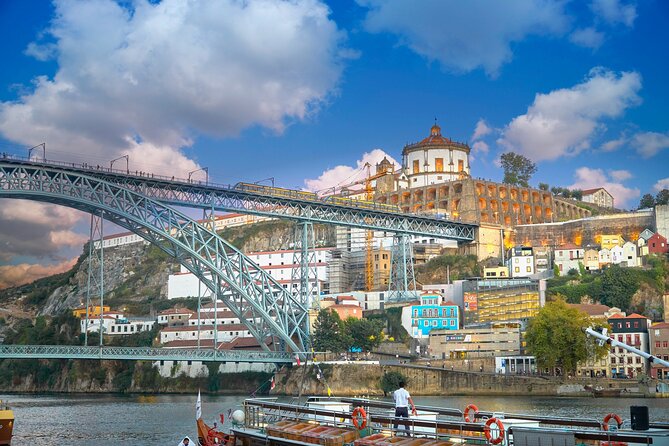
Then comes one of Porto’s headline structures: Ponte Dom Luís I. This bridge was planned by Teófilo Seyrig, a disciple of Eiffel, and inaugurated in 1886.
It’s made of two overlapping iron decks, and it stretches 395 meters long and about 8 meters wide. The arch is still considered the world’s biggest forged-iron arch, a fact that lands best when you’re near the structure, not just reading it on a sign.
The upper deck is now used by the Metro of Porto, connecting areas from the Cathedral zone toward the Garden of Morro and toward Avenida da República in Gaia. Even if you don’t ride the Metro during your tour, seeing how the bridge continues to function is key. Porto doesn’t treat icons as museum pieces. It keeps them working.
Some other granite-city outings to weigh
- Porto PRIVATE TOUR With Locals: Highlights & Hidden Gems
★ 5.0 · 984 reviews - Porto: Private Tour of the Historic City in a Ford T Car
★ 4.8 · 932 reviews - Porto: Private tour in the Douro (1 to 4 people) on a boat just for you
★ 5.0 · 744 reviews - Porto Private Food and Drink Tasting Tour with Local
★ 5.0 · 652 reviews
Igreja de São Francisco and the baroque gold effect
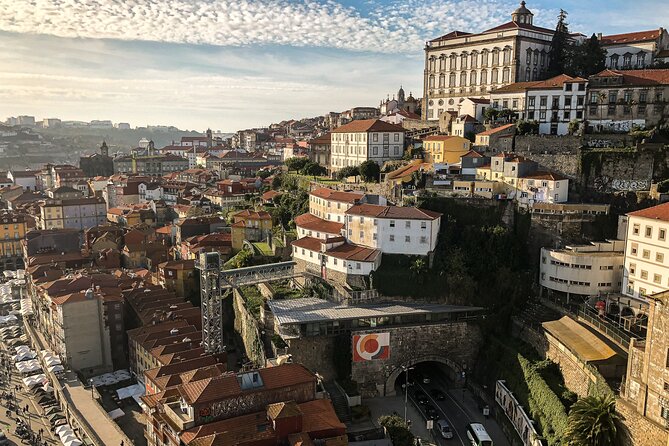
From the bridge area, you’ll move into a religious stop built to impress. Igreja de São Francisco is a Gothic temple whose construction began in the 14th century, but what visitors talk about is the baroque interior filled with gilded carved woodwork.
The tour’s time here is brief, but the details are what make it worth it:
- The Tree of Jesse.
- The catacombs (even if you don’t spend extra time there, they shape the atmosphere).
- The interior’s ornate “church of gold” look, which is exactly why it has an international reputation.
This spot is both a National Monument since 1910 and a UNESCO World Cultural Heritage site since 1996. That’s a quick way to understand why it’s on every serious Porto list.
Palácio da Bolsa and Arabian Room: Porto’s moneyed side
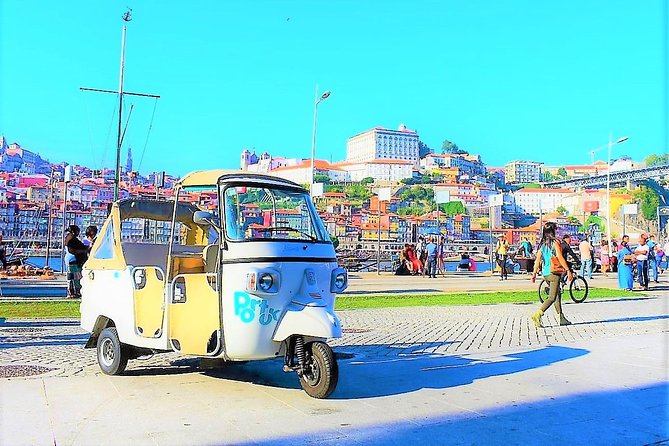
Next, you’ll hit Palácio da Bolsa, the Stock Exchange Palace. It became the headquarters of the Commercial Association of Porto, and the building was designed in a neoclassical style in 1842.
Even if you’re not a history buff, the layout is interesting because it shows Porto’s commercial power and how formal spaces signaled stability. The major highlight is the Arabian Room, which is the kind of room you can’t fully appreciate from a photo alone.
This stop typically runs as a short break in the loop, around 20 minutes in the broader city center timing. Since it’s a major attraction, go with the expectation that you’ll see the room, then move on. You’re not losing the day to one building, which is exactly the point of a half-day tour.
Ferreira Borges square and the Infante D. Henrique monument
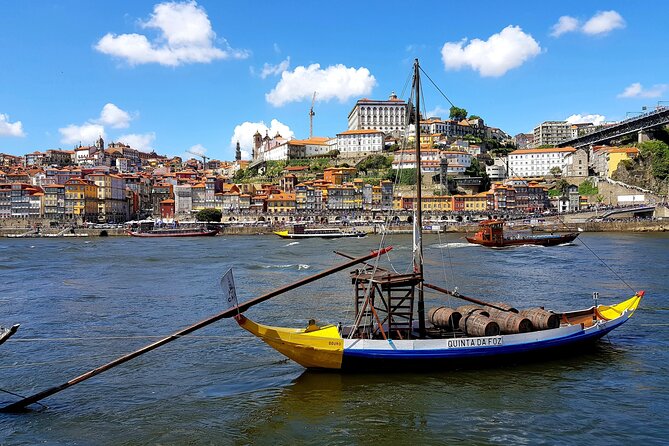
Close by is a smaller square surrounded by major buildings, where you get a breather and a different kind of Porto story. The square sits near Mercado Ferreira Borges and Palácio da Bolsa.
Under the area is a small garden and an underground car park, and the square centers on a Monument to Infante D. Henrique. The monument’s construction started in 1894 and finished in 1900, celebrating the 500th anniversary of his death. It’s a tribute to Portuguese navigation and faith, which makes sense in a city shaped by the river and trade.
This stop is useful because it’s a reset between bigger sights, and it helps you see the city’s “Porto as a maritime trading hub” theme.
Jardins do Palácio de Cristal: your break from stone and stairs
Then you get to do something Porto does well: gardens with city views. Jardins do Palácio de Cristal is one of the city’s best-loved escapes, and the best way to describe it is as a mosaic of small gardens that reveal themselves as you wander.
Expect:
- Lawns and sun-dappled paths.
- Fountains and sculptures.
- Large trees like giant magnolias.
- Camellias, cypress, and olive trees.
- And, crucially, viewpoints over both the city and the Douro River.
Your stop here is often about 20 minutes with free admission. This is where you get your “sit down, breathe, stop gripping the camera” moment. If you’re traveling with someone who gets tired of walking, this garden stop turns the tour into something more balanced.
Mercado Ferreira Borges and Alfândega Nova: iron architecture and reuse
After the river views and gardens, the route often heads back toward the center with a couple of architectural culture stops.
One highlight is Mercado Ferreira Borges, built in 1885 by city order to replace an older Ribeira market. It operated briefly as a market, then shifted roles. Today it’s a venue, and the building is known as an important example of iron architecture in Porto. It’s also been renovated into an entertainment space, including Hard Club.
Next comes the Alfândega Nova do Porto complex, a neoclassical building from the 19th century, planned by engineer Jean F. G. Colson. It uses iron combined with stone, brick, and wood depending on the space’s function. Later, it was adapted for the Museum of Transport and Communications, with restoration guided by architect Eduardo Souto Moura.
If you like seeing how Porto reuses structures instead of demolishing and starting over, these two stops hit the sweet spot. They’re quick, but they explain the city’s “reuse the shell, keep the spirit” approach.
Carmo and Clérigos: two tower-and-church moments that define the skyline
Porto’s baroque and rococo churches can feel over the top in the best way, and this route includes two of the big hitters.
The Igreja dos Carmelitas stop often lasts only a few minutes. It’s a 17th-century church with a classical façade dating from the 1850s, linked to the architect/painter Nicolau Nasoni. The rococo-style altarpiece is described as a revolutionary piece of Porto rococo style, and the stop is free admission.
Then comes Torre dos Clérigos. The tall bell tower is one of Porto’s most recognizable symbols, and you can see it from multiple points across town. Admission is not included here, so consider whether you want to pay for the climb based on your energy and your schedule.
Next is Igreja do Carmo, a national monument with interior carvings that make it stand out as a top rococo site. Its lateral façade was covered with tiles in 1912, designed by Silvestre Silvestri, with figurative scenes linked to the cult of Nossa Senhora (Our Lady). Admission is also not included for this stop.
Finally, you pass Fonte dos Leões, a 19th-century fountain made in France (Val d’Osne foundry) as a copy of a fountain in Leicester. It’s a small stop but gives you a breather from major churches and helps you keep moving without feeling like you’re just queueing.
Cordoaria Garden, the old prison, and Camilo’s shadow
One of the quieter, more interesting stops is Cordoaria Garden, also known as Jardim de João Chagas. It was named after João Chagas in 1924, but the area’s earlier identity is tied to rope makers who lived and worked here for around 200 years.
The garden project by German landscaper Emile David dates to 1865/1866, and it includes statues of Ramalho Ortigão and António Nobre, plus sculptures by Juan Muñoz from 2001. This is a great “slow down” stop inside a fast half day.
Then you’ll reach Antiga Cadeia da Relação, an old granite building dating to 1582, rebuilt in 1767 in neo-classical style. It has a geometric pattern of windows, and the building has four façades, with entrances tied to its historical role. Famous names associated with the prison include writer Camilo Castelo Branco and outlaw Zé do Telhado.
Today, the building has been restored and repurposed as the Portuguese Centre for Photography, managed by a restoration project linked to Eduardo Souto Moura and Humberto Vieira.
This is one of those stops where the short time actually works, because the building instantly prompts questions. Why a geometric window pattern? Why that layout for prisoners? Repurposed historic buildings make Porto feel real, not staged.
Livraria Lello: the red staircase and the decision to pay
Finally, the route typically circles toward Livraria Lello. The building opened in 1906 and is known for its Art Nouveau façade with neo-Gothic details.
Inside, you’ll find painted plasterwork imitating wood and a striking staircase that connects floors. The skylight is huge, and it carries the library monogram and motto, Decus in Labore.
Admission is not included for Livraria Lello, and the stop time tends to be around 10 minutes. That means you need to decide quickly whether you want the paid interior experience or just the exterior and nearby photos.
Wine tasting and pacing: how to make the half day feel worth it
Wine tasting is listed as part of the experience. In the real world, half-day schedules can get tight when streets get congested, or when your group’s pace shifts.
My advice is simple: if wine tasting is important to you, ask your guide early about when it fits in. You want to protect that time, not scramble at the end.
Also, think about your priorities. If you’re aiming for architecture and viewpoints, this tour does that well. If you want a deep museum day, you’d be better off saving that energy for later. The value here is speed plus meaning, not slow immersion.
Should you book this Porto half-day private tuk tuk tour?
Book it if you want a fast orientation to Porto with stops that actually connect to the city’s story, not just a random “look at this, next!” loop. It’s also a strong pick for travelers who hate steep hills, or who want to cover Porto and Gaia without building an exhausting walking plan.
Skip it or choose carefully if you’re sensitive to schedule changes. A half day in Porto is always at the mercy of traffic and the need to fit many short stops in a row. If you want maximum time inside paid attractions like Torre dos Clérigos, Igreja do Carmo, or Livraria Lello, make sure you’re ready to spend extra moments once you’re there.
If you’re the type who likes to get your bearings fast, ask a few pointed questions, and then come back on your own for longer visits, this is a smart way to start a trip in Porto.
Fresh off the Porto quays


Tuk-Tuk Tours, compared.
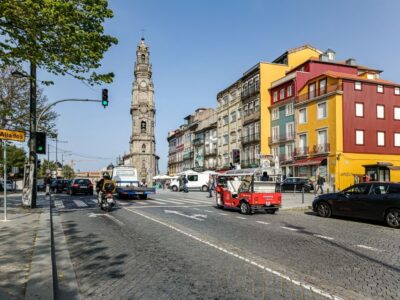
Guided Tour by Tuk-Tuk & Optional Douro River Cruise
Read our review →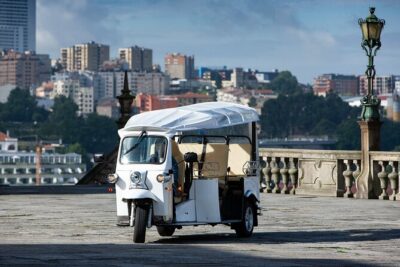
Discover Porto’s Highlights on a 2-Hour Private Electric Tuk Tuk
Read our review →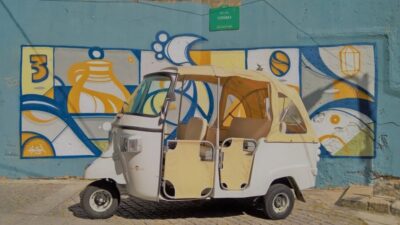
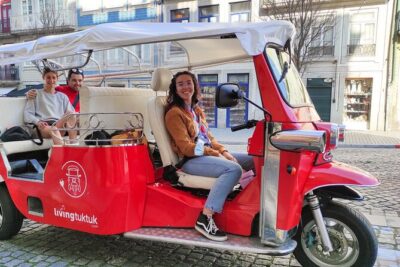
Historic Porto by Private Electric Tuk Tuk to Top Landmarks
Read our review →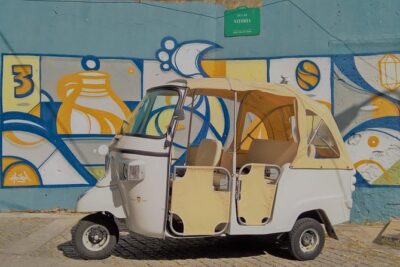
Porto Guided Tour to the Historical Center on a Tuk Tuk
Read our review →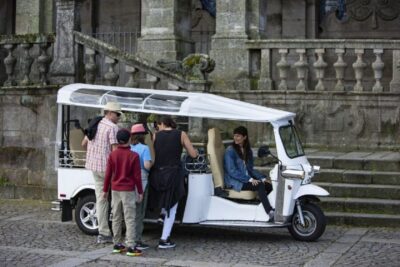
Oporto Tuk-Tuk Tour: Fast, Fun & Flexible – 1H to Full Day!
Read our review →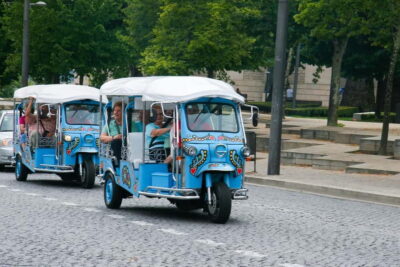
Browse the lists this tour appears in