
Reviewed · EVENING EXPERIENCES
Porto private night Tour, discover the most iconic attractions
Porto feels different after dark, like the city exhales. I love how this is a private tour that turns the lights on key sights without the push and shove, and I really like the onboard Wi-Fi that keeps you connected while you’re moving between neighborhoods. One thing to consider: some of the star attractions here have entry fees that are not included.
You’ll ride in a comfortable vehicle with water and refreshments, and your guide will focus on what you’re looking at, from medieval walls to Baroque churches to big river bridges. In the reviews, guide Carlos stands out for being punctual and for packing in history in a way that actually sticks.
In This Review
- Key highlights at a glance
- Porto at night, with your own pace
- Price and what you actually get for $184.84
- Getting going: Praça da Liberdade and downtown pickup
- Avenida dos Aliados mood and the D. Pedro IV statue stop
- Mercado do Bolhão after dark, and why it matters
- Praça da Batalha: a historic square and Teatro São João context
- Muralha Fernandina and the medieval city boundary
- A Gothic building façade with a Renaissance portal detail
- Catedral do Porto: medieval structure, many renovations
- São Bento Railway Station tiles: a free art lesson
- Café Majestic and the Galerias Palladium clock show
- Clérigos Tower: 240 steps and wide views
- Livraria Lello: Art Nouveau exterior and the famous interior staircase
- Baroque churches and Casa Escondida between them
- Big interiors with extra fees: Igreja de São Francisco
- Palácio da Bolsa and the Arab Room, a visual payoff
- Bridges and river crossings: engineered Porto in motion
- Jardim do Morro and Serra do Pilar in Gaia
- Modern Porto at sea: Arrábida Bridge, forts, and Leixões
- Serralves, Casa da Música, and contemporary Porto choices
- Praça de Mouzinho de Albuquerque: a 45m monument to alliances
- Optional add-ons after your 3-hour loop
- Fado with port wine (1 hour)
- Dona Antónia exclusive port wine cellars (1h30)
- Should you book this private Porto night tour?
- FAQ
- How long is the Porto private night tour?
- What does the tour cost, and is it private?
- Where does the tour start and end?
- Do I need to pay entrance fees at the stops?
- Is pickup included?
- Is the guide language English?
- Are there optional add-ons, like fado or a port wine tour?
Key highlights at a glance
- Private pacing for your group only, not a big crowd shuffle
- Onboard Wi-Fi plus bottled water and refreshments during the tour
- City views at night, including tower and riverside viewpoints where you can slow down
- Iconic interiors and façades, from São Bento tiles to Baroque church details
- UNESCO bridge area photo stops, with context so the structures make sense
- Two smart add-ons if you want music or wine after the 3-hour loop
Porto at night, with your own pace
A night tour in Porto is mostly about tempo. In the day, people swarm the same corners. At night, the city looks more personal, and you can take in details on stone and tile without fighting for position.
This one works because it is private. Your group sets the rhythm, and you can pause when something catches your eye, like a façade detail, a panoramic overlook, or a street that feels like it belongs in a movie set.
I also like that you are not just looking out the window. This tour is built around explanation, so you see why places matter, not only what they look like. That mattered in feedback about Carlos too, where people liked the clear history and the way he adjusted to the evening.
More Porto evenings already booked out:
- Porto: Bridges Cruise & Sunset & Port Wine Cellar Option★ 4.2 · 4,180 reviews
- Porto: Douro River Party Boat with Sunset Option & 6 Bridges★ 4.7 · 2,040 reviews
- Porto: 6 Bridges Cruise & Port Wine with Sunset Option★ 5.0 · 997 reviews
- Porto Douro River Cruise With Port Wine – Daytime or Sunset★ 4.5 · 759 reviews
Price and what you actually get for $184.84
At $184.84 per person for about 3 hours, you’re paying for more than a checklist. The big value is the comfort and the time saved moving around the city at night, when walking can feel slower and less predictable.
You get:
- Luxury vehicle transport with onboard extras
- Wi-Fi, bottled water, and refreshments during the ride
- Personal accident and liability insurance
- English-speaking guide
- Pickup from downtown hotels and B&Bs in Porto and Gaia
What is not included is also important for value. Several major stops have entry tickets that cost extra, including places like the Cathedral, the Clérigos Tower, Livraria Lello, and the big Baroque church and landmark buildings later in the route. So if you want every interior, budget for those added tickets.
Getting going: Praça da Liberdade and downtown pickup
The tour starts and ends back at Praça da Liberdade (19, 4000-322 Porto). If you are staying in a downtown hotel or B&B in Porto or Gaia, pickup is offered, which is a relief because evening traffic and parking can turn a simple plan into a hassle.
You do not have to wrestle with directions mid-tour. The vehicle handles the hops, and you get a planned sequence of stops. In a rainy evening review, the guide also kept things moving and worked with the group for photos, which is exactly what you want from a night plan.
Avenida dos Aliados mood and the D. Pedro IV statue stop
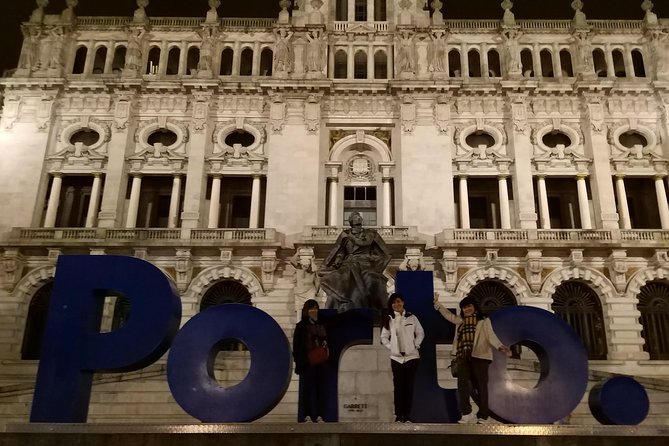
Early in the evening, you start in the grand, civic part of central Porto. The route runs through a wide avenue lined with buildings from the 1920s and 1940s, and it connects toward the area where Porto Town Hall sits. This kind of setting helps you get oriented fast.
Then you’re pointed toward D. Pedro IV, the Liberator, in front of Cardosas Palace at D. Pedro Square. The statue is simple to spot, but the context matters. It frames Porto’s identity as a city shaped by political turning points, not only by food and views.
Mercado do Bolhão after dark, and why it matters
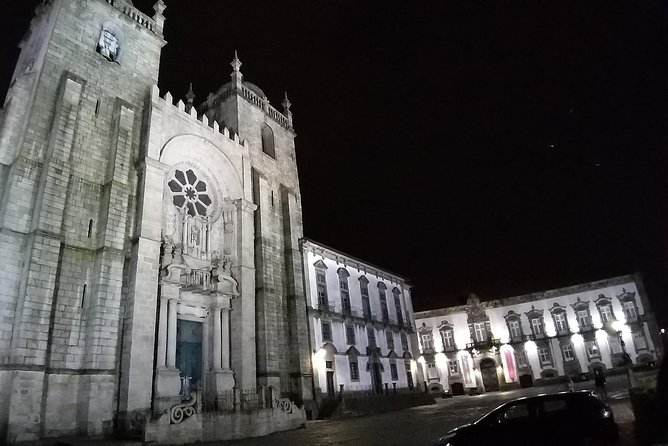
Next is Mercado do Bolhão, described as Porto’s most emblematic market. The building dates to 1850, with a two-floor structure and neoclassical architecture. Even if you only see it from outside at night, it’s the kind of place where the city’s daily rhythm is still the point.
The market focuses on fresh products and is organized into specialized sections, like fish, butchers, vegetables, and florals. This stop is a good reminder that Porto is not a museum city. It’s still living, buying, selling, and going about its business.
Some other granite-city outings to weigh
- Discover Porto’s Highlights on a 2-Hour Private Electric Tuk Tuk
★ 4.5 · 1,860 reviews - Porto PRIVATE TOUR With Locals: Highlights & Hidden Gems
★ 5.0 · 984 reviews - Porto: Private Tour of the Historic City in a Ford T Car
★ 4.8 · 932 reviews - Porto: Private tour in the Douro (1 to 4 people) on a boat just for you
★ 5.0 · 744 reviews
Praça da Batalha: a historic square and Teatro São João context
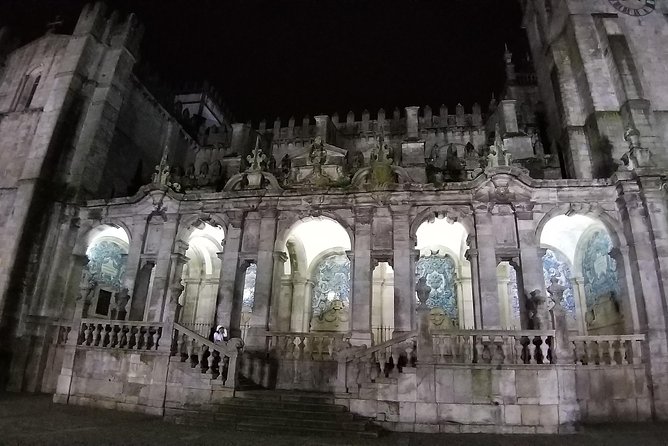
You then move to Praça da Batalha, where the name connects to a battle tied to Porto’s medieval troubles, around the 10th century. It’s a reminder that names in Portugal often preserve old stories, even when you might assume a more recent event.
The square is also home to Teatro São João, inaugurated in 1798. The theater’s arc includes a fire in 1908, which adds a layer of drama to something that looks elegant and calm from the street.
This stop is short, but it helps you read the city. Instead of seeing random squares, you start recognizing how the city grew and why specific spaces became important.
Muralha Fernandina and the medieval city boundary
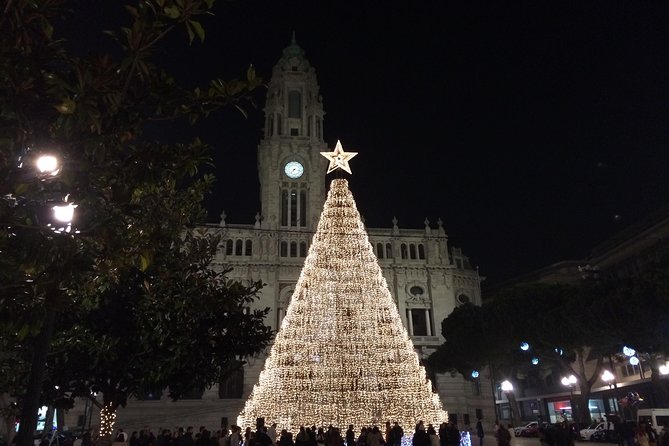
When you see Muralha Fernandina, you’re looking at a defensive wall designed in the 14th century to replace older fortifications as Porto expanded. The work nearly finished around 1370, but completion stretches into the reign that gave the wall its name, with final stages continuing into the early 1400s.
Then, much later, the wall stops being military necessity, and parts are demolished. That makes surviving sections feel like historical breadcrumbs. It is an excellent stop for night because walls and stone edges catch light in a way that makes their age visible.
A Gothic building façade with a Renaissance portal detail
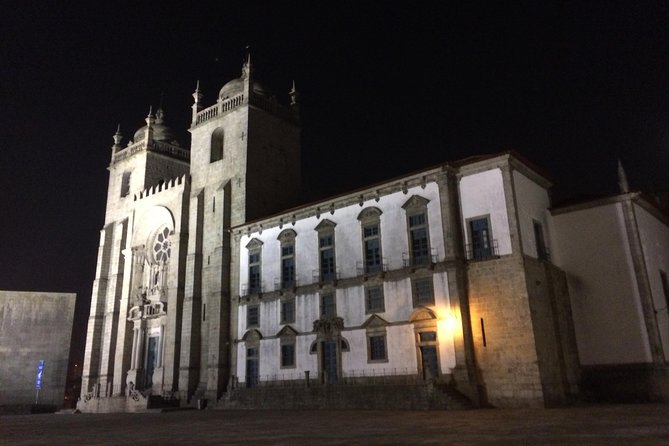
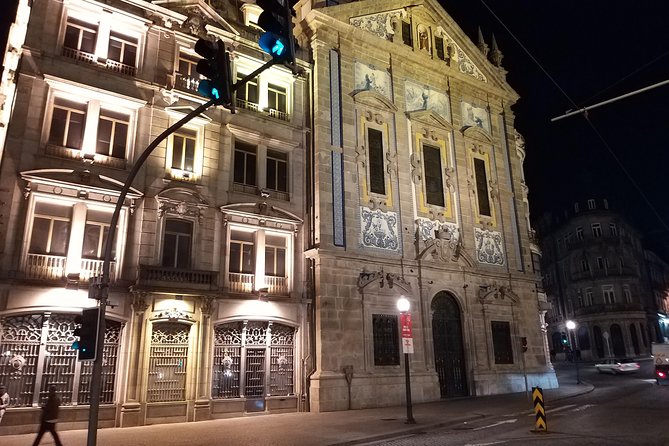
There’s also a quick visual stop at a Gothic-origin building with original construction dating to the 15th century. In the 17th century, changes were made, including a Renaissance portal and gilded carvings inside.
This is the kind of thing I like on a night tour, because the exterior details give you an immediate wow factor. If you’re the sort of traveler who enjoys noticing stonework and architectural layers, you’ll feel at home here.
Catedral do Porto: medieval structure, many renovations
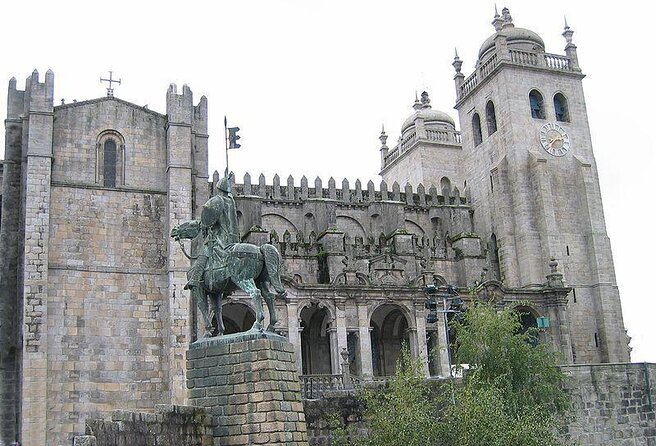
Catedral do Porto is a key stop, dated to the 12th or 13th century and expanded and renovated over centuries until a final configuration formed in the 20th century. The important part is that it kept its medieval cathedral layout while adding layers around it.
The highlight mentions include the Gothic Chapel of St. John the Evangelist and its cloister, plus the expansion of the chancel and the Chapel of the Blessed Sacrament with a silver altar.
Tip for your planning: admission is not included here, so decide in advance if you want interior time. If you do, expect the tour to pause long enough for a meaningful look, but it will still be tight, given the overall 3-hour flow.
São Bento Railway Station tiles: a free art lesson
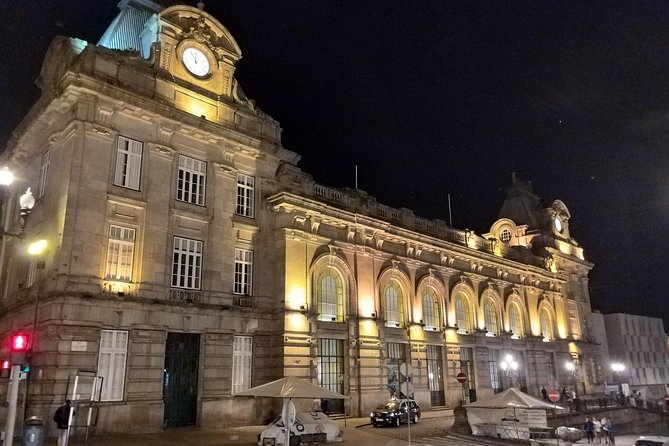
If you want one must-stop on this entire route, it’s São Bento Railway Station. It was built in the early 20th century at the site of an older 16th-century convent, and the station vestibule is decorated with 20,000 painted tiles by Jorge Colaço.
Those tiles trace evolution of transport and events from Portuguese life in the region. At night, even from a quick stop, the station feels alive because it is still functional. That means you’re seeing art in its real context, not in a quiet gallery room.
Admission is free, so this one is a straightforward win.
Café Majestic and the Galerias Palladium clock show
Next up is Café Majestic, opened in 1921 and tied to Porto’s Belle Époque era. It’s Art Nouveau inside, with marble, gilded mirrors, and intricate woodwork. Even without an extra ticket, the café is worth treating like a landmark stop.
Close by, you’ll also find the Relógio das Galerias Palladium. The clock has a carillon and four statues that perform every three hours, representing figures from Porto’s history: São João, Infante D. Henrique, writer Almeida Garrett, and novelist Camilo Castelo Branco.
This stop is great if you like small theatrical details in real public spaces. Just note that admission is not included for Café Majestic itself in the tour listing.
Clérigos Tower: 240 steps and wide views
Torre dos Clérigos is one of Porto’s most iconic monuments, built in the first half of the 18th century by Nicolau Nasoni in Baroque style. The climb is 240 steps, and the reward is a panoramic view of the city and the Douro River.
The tour notes also point out its pop-culture moment in the film Suicide Squad. Whether or not you care about that, the practical reason to go up is simple: Porto is a steep city, and night light plus elevation makes the layout easier to understand.
Admission is not included, so again, decide if you want the tower interior and climb. If you do, bring comfortable shoes, because steps add up fast.
Livraria Lello: Art Nouveau exterior and the famous interior staircase
Livraria Lello sits in a building opened in 1906, with an Art Nouveau façade that includes Neo-Gothic details. Inside, you’ll find painted plasterwork imitating wood, a dramatic staircase connecting floors, and a huge stained-glass skylight.
There’s also a monogram and motto visible in the design. This is the stop that feels most like a “yes, I get why people talk about this place” moment.
Admission is not included, and the tour is time-tight, so I’d treat this as a quick but focused stop. If you want a slow linger, plan for extra time beyond the 3-hour tour.
Baroque churches and Casa Escondida between them
You’ll spend time in the area of Igreja do Carmo and Igreja das Carmelitas, two Baroque churches with strong visual identity. The Igreja do Carmo is known for azulejos on its exterior, and the Carmelitas has a striking ornate façade across the street.
What I really like about this stretch is the mention of the Casa Escondida or Hidden House, tucked between the churches. It’s a small space, but the story is big: it shows how people built creatively in a dense area, when there simply was not room to spare.
Admission is free for these church exteriors and this stop area. Even if you skip interior time, it’s a great zone for photos and architectural curiosity.
Big interiors with extra fees: Igreja de São Francisco
Igreja de San Francisco is described as the most important Gothic temple in the city, with construction begun in the 14th century, and then a Baroque interior added later. The interior is especially known for its golden woodwork, to the point that it has been called a Church of Gold.
The tour also flags the Tree of Jesse and visiting the catacombs. This is a stop where, if you care about interiors, you’ll likely want more time than a quick glance.
Admission is not included, so include that in your night budget.
Palácio da Bolsa and the Arab Room, a visual payoff
Later you reach Palácio da Bolsa, the Commercial Association of Porto. It is neoclassical, designed by Joaquim da Costa Lima in 1842, built on the site of a former convent destroyed by fire during the Siege of Porto.
The tour notes highlight the Arab Room as the standout feature. Even if you only know the name, it’s usually what people are hunting for.
Admission is not included, but it is one of the most classic “worth the ticket” types of landmarks on a city night route, because the room details are usually the entire point.
Bridges and river crossings: engineered Porto in motion
This tour gives you the chance to see Porto’s bridge history as a progression, not a random photo backdrop.
You’ll pass the remnants of the earlier suspension bridge called D. Maria III, inaugurated in 1843 and deactivated after four years due to insecurity of travelers. Only two stone pillars shaped like obelisks remain.
Then comes Ponte D. Maria Pia, created to replace that suspension bridge. It’s Gustave Eiffel’s first masterpiece, worked on with Theóphile Seyrig, inaugurated in 1877, and in operation for 114 years until replaced by São João Bridge.
You’ll also see a railway bridge solution linked to Edgar Cardoso, connecting Campanhã station to southern destinations, inaugurated on St. John’s Day in 1991.
And there’s the bridge inaugurated March 30, 2003, a Maillart-type arch described as very slender, with a long deck and a large arch span. The tour notes also mention it carries a Porto Metro line. If you’re into engineering, this is where the night stops feel less like sightseeing and more like understanding why Porto became famous.
Jardim do Morro and Serra do Pilar in Gaia
Once you cross over into Gaia viewpoints, the mood changes. You slow down and look outward.
Jardim do Morro is a public park with panoramic views. It’s a natural place for night photos because you get a layered view of Porto without needing a ticket for the view itself. Admission is free.
Then you reach Mosteiro da Serra do Pilar. The church and cloister are described as circular shapes, tied to classical European architecture. Construction began in 1538 and happened in stages over centuries, leading to changes from the initial design.
Admission is free here, which makes it a strong value stop. The monastery is classified as a National Monument and part of the UNESCO listing along with the historic center and the Luís I bridge area.
Modern Porto at sea: Arrábida Bridge, forts, and Leixões
The tour continues with more modern and coastal references.
The Arrábida Bridge is described as an example of reinforced concrete engineering, once the longest of its type, inaugurated in 1963, and standing about 70 meters above average water level. Bronze sculptures sit on top of large pillars, adding a sculptural, modern touch to a bridge that could have felt purely functional.
Then you get a pair of forts: Fortress São João Baptista, built at the end of the 16th century to protect the coast and the entrance to the Douro, with later additions in the 17th century and access gate updates in the 18th. And Castelo do Queijo, a fort called Cheese Castle because it sits on a rocky hill shaped like cheese, built in the 17th century to protect against North African pirates.
Admission for these forts is not included.
After that, there’s Estatua Equestre de D. João VI, an elevated granite base with a metal statue of the king, plus a crown and legend. The sculpture holds reins and a balloon, tied to imperial dignity marked by the union with Brazil and the Algarves. It’s a short stop, but it adds a human scale between big stone and big engineering.
Finally, you see She Changes, known as Anemone, a net-like sculpture by Janet Echelman for Porto and Matosinhos. The idea is motion, created by wind across a fishing net form. If it’s windy, it looks like it is alive.
You’ll also hear about Leixões Port and cruise operations, including the cruise pier opened in April 2011 and growth in cruise passenger visits. This is useful context if you’re traveling around during cruise season, because you’ll understand where those crowds might be coming from.
Serralves, Casa da Música, and contemporary Porto choices
This tour does not only do old stone. It also gives you a modern cultural side.
At Serralves Park, you see the Serralves House, a notable Art Deco example built in the 1930s and set inside a park with designed gardens, a traditional farm, and even a forest. It’s linked to the Museum of Contemporary Art and the Art Deco House.
Then you reach Casa da Música, Porto’s main concert hall designed by Rem Koolhaas and inaugurated in 2005. The building is treated as a contemporary icon, and seeing it from outside at night gives you an immediate sense of the city’s current identity.
Praça de Mouzinho de Albuquerque: a 45m monument to alliances
In the Boavista area, you get Praça de Mouzinho de Albuquerque. The monument in the center includes a 45m high statue, inaugurated in 1951, with an obelisk and sculptural groups that represent Portuguese and English unity and victory against French Napoleonic armies.
The iconography is built into the idea: a lion representing union with England, and an eagle for victory. It’s a good last “big picture” stop, especially after hours of details.
Optional add-ons after your 3-hour loop
If you want the night to last longer, you have two optional directions.
Fado with port wine (1 hour)
The optional Fado show includes port wine tasting and runs daily at 18:00 and 19:30. Price is €20.00 to €26.00. The listing frames it as an authentic experience tied to fado as an Intangible Cultural Heritage tradition.
If you book this, it starts 2 hours earlier than the standard tour start time listed for the main experience, so your scheduling matters.
Dona Antónia exclusive port wine cellars (1h30)
The other optional add-on is the Dona Antónia style port cellar tour. It lasts 1 hour 30 minutes, includes a tasting of 5 port wines, and costs €32.00 to €41.00. The description focuses on Dona Antónia Adelaide Ferreira and her role in shaping the Douro and port wine’s prestige.
This optional also starts 2 hours earlier than the main tour start time. If you’re choosing between the two add-ons, pick based on what you want more, music or the wine story.
Should you book this private Porto night tour?
Yes, with a few smart checks.
Book it if:
- You want a private, English-guided way to get bearings without crowds
- You care about architecture and want context, from medieval walls to Baroque interiors
- You like night photos and viewpoints, not only restaurant stops
- You want comfort, with onboard Wi-Fi and refreshments during the ride
Maybe skip or adjust if:
- You only want a small number of paid-entry interiors, because multiple highlights have ticket costs not included
- Your group hates stairs, since Clérigos Tower involves a climb and the cathedral and church stops may require walking inside
My final take: this is a strong choice for an evening that feels organized, human-sized, and properly Porto. The “value” comes from the transport comfort plus the way you’re shown the city as a story, not just a route. If you plan ahead for extra entry tickets and you pick one add-on, you’ll end the night with real understanding, not just photos.
FAQ
How long is the Porto private night tour?
It lasts about 3 hours.
What does the tour cost, and is it private?
The price is $184.84 per person and it is a private tour, meaning only your group participates.
Where does the tour start and end?
The meeting point is Praça da Liberdade 19, 4000-322 Porto, Portugal, and the tour ends back at the meeting point.
Do I need to pay entrance fees at the stops?
Some stops have admission tickets not included, including Catedral do Porto, Torre dos Clérigos, Livraria Lello, Igreja de San Francisco, and Palácio da Bolsa, plus Fortress São João Baptista and Castelo do Queijo. Many other stops are listed as free.
Is pickup included?
Pickup is offered from downtown hotels and B&Bs in Porto and Gaia.
Is the guide language English?
Yes, the tour is offered in English.
Are there optional add-ons, like fado or a port wine tour?
Yes. You can add:
- Fado show with port wine, €20.00 to €26.00, about 1 hour, daily at 18:00 and 19:30
- Exclusive Dona Antónia port wine cellars, €32.00 to €41.00, about 1h30, with tasting of 5 port wines
Fresh off the Porto quays



Evening Experiences, compared.

Bridges Cruise & Sunset & Port Wine Cellar Option
Read our review →
Douro River Party Boat with Sunset Option & 6 Bridges
Read our review →
Charming Sailboat Cruise with Port Wine,Sunset Option
Read our review →
6 Bridges Cruise & Port Wine with Sunset Option
Read our review →
Porto Douro River Cruise With Port Wine – Daytime or Sunset
Read our review →
Daytime or Sunset Douro River Cruise With Port Wine
Read our review →
6 Bridges Cruise, Welcome Drink & Sunset Option
Read our review →
Browse the lists this tour appears in