
Reviewed · BRAGA & GUIMARãES DAY TRIPS
Guimarães Medieval Tour
Guimarães has a way of slowing time. This small-group 9-hour medieval tour from Porto feels value-heavy because you get a local guide, pickup and drop-off, and admission to key monuments while still moving at a human pace. I especially like how the day mixes palace and church stories with scenery from the Penha mountain. One consideration: lunch is not included, so you will want to plan ahead if you get hungry midday.
What you are really buying here is clarity. The route is built around the core places tied to Portugal’s early national story, then it expands into suburbs and viewpoints, so you leave with a connected picture instead of a stamp-collecting day. The guide for this experience is Ricardo, and that matters because his explanations turn stones into plot points.
The only real drawback is pacing. Several stops are short (think 10 to 20 minutes), which is great for packing in the most important sites, but you will want to choose what you linger on. Also, the tour requires good weather since it includes walking in and around the Penha area.
In This Review
- Key things I’d focus on before you go
- Price and what makes it feel fair at $144.83
- The day starts in Porto, then heads straight for Portugal’s medieval core
- Guimarães Castle: Norman-inspired Gothic, with royal power underneath
- Igreja de São Miguel do Castelo: baptism, admin meetings, and medieval continuity
- Paço dos Duques de Bragança: a long look at how palaces become ruins, then monuments
- Baroque stop with Carmo church and convent energy
- The old city street linking castle and convent, plus Santa Clara area context
- Centro Histórico de Guimarães: UNESCO walls you can actually walk
- Igreja de Nossa Senhora da Oliveira and the olive tree origins
- Largo da Oliveira: the olive tree square and a shrine tied to 1340
- Montanha – Parque da Penha: tiles, caves, and big viewpoint energy
- What’s included, what’s not, and how to plan your day
- Best for: history lovers who still like scenery and short walks
- Should you book the Guimarães Medieval Tour?
- FAQ
- What is the duration of the Guimarães Medieval Tour?
- Where does the tour start and end?
- What time does the tour begin?
- How big is the group?
- Is pickup and drop-off included?
- Are monument entrance fees included?
- Does the tour include a mountain or nature element?
- Is lunch included?
Key things I’d focus on before you go
- Max 6 travelers means you can ask questions and actually hear the guide.
- Pickup and drop-off in Porto saves time and stress on a full-day plan.
- Monument entrances included for major stops helps the value feel real.
- UNESCO-listed historic center gives you a medieval core that is still intact.
- Penha mountain viewpoints add nature and photo time without turning it into a full hike day.
- Photos of the tour are included, which is handy if you do not want to manage your camera nonstop.
Price and what makes it feel fair at $144.83
At $144.83 per person for about 9 hours, the price only makes sense if you get more than a quick drive and a walking loop. This tour is structured so you do. You get pickup and drop-off from Porto, a local guide, insurance, taxes and fees, and photos of the tour. On top of that, multiple monuments have admission included.
If you have ever done day trips where you pay a ticket price that turns out to be mostly “viewpoints only,” this one is different. Several of the central stops are specifically called out with ticket access, including the big hitters like Guimarães Castle and Igreja de Nossa Senhora da Oliveira. That is where your money quietly works for you, because you are not juggling payment at each doorway.
Group size is another hidden value lever. With a maximum of 6 people, the guide can keep the group moving without feeling rushed all the time, and you are not stuck listening over a crowd.
North to Braga and Guimaraes, other trips:
- From Porto: Braga and Guimarães Full-Day Trip★ 4.6 · 3,951 reviews
- Best of Braga and Guimaraes Day Trip from Porto★ 4.5 · 2,552 reviews
- Porto: Guimarães & Braga Tour with Entry Tickets and Lunch★ 4.8 · 602 reviews
- From Porto: Braga & Guimarães with Lunch Small Group Tour★ 4.8 · 545 reviews
The day starts in Porto, then heads straight for Portugal’s medieval core
The meeting point is in Porto at R. de Guilherme da Costa Carvalho 38, and the start time is 8:30 am. The tour ends back at the same meeting point, which keeps the day simple. You avoid the hassle of figuring out transit to Guimarães on your own, and you also get an earlier start so you are not arriving too late for the main monuments.
This matters because Guimarães is made of layers. When you show up in the morning, the historic core still feels fresh, and you can better understand why certain churches and palaces sit where they do, from castle hill down to the old city.
Also, the tour is designed for most travelers. So if you want medieval sights without committing to a strenuous climb for hours, this is the kind of day trip that usually fits.
Guimarães Castle: Norman-inspired Gothic, with royal power underneath
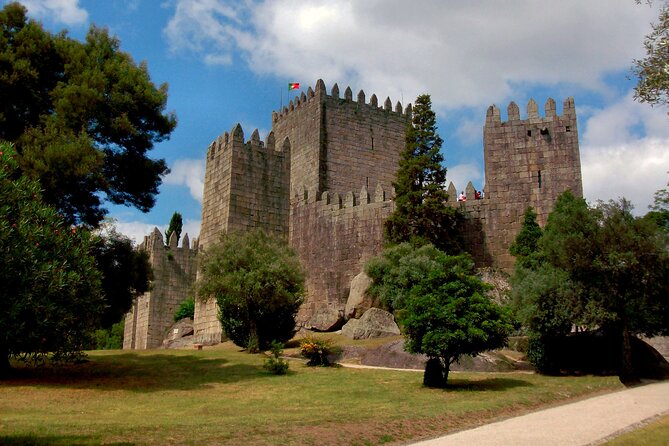
Your first major stop is Guimarães Castle, and the timing is short, around 20 minutes with admission included. That might sound quick, but castles in Portugal are not about long museum time. They are about positioning, walls, and what the site communicates.
Here’s what makes this particular castle-and-palace story worth your attention. The palace of the Dukes of Bragança was begun in the early 15th century, commissioned by D. Afonso de Barcelos, the first Duke of Bragança. He was the bastard son of D. João, Master of Avis, who later became King D. João I. So even before you even get into the details, the place is tied to the formation of Portugal’s early ruling story.
The palace did not stay as a palace. When the Dukes moved their residence to Vila Viçosa in the Alentejo, the building fell into disrepair and was later turned into a military barracks in 1807. Then restoration began in 1937, and on 24 June 1959, exactly 831 years after the Battle of São Mamede, the palace was brought back to life in its Norman-inspired Gothic look.
That timeline is more than trivia. It explains why you see layers of function. This is why castles can feel confusing when you just look at walls. A guide gives you the connecting thread: royal ambitions, neglect, military use, then modern restoration.
Igreja de São Miguel do Castelo: baptism, admin meetings, and medieval continuity
Next up is Igreja de São Miguel do Castelo. Plan on about 15 minutes, and admission is included. This church links directly to the foundation story of Portugal, because Afonso Henriques, the first king of Portugal, is believed to have been baptized here.
A small detail like that changes how you experience the site. A church is not just an architectural object. It becomes a hinge in national origin stories, which is why this stop fits well into the medieval theme day.
The oldest known reference to the church dates to 1216. In medieval times, the porch served as a meeting place for town council hearings, so it was not only for worship. It was also a social and administrative spot, a shared public “in-between” space.
Then there is a tangible example of how church objects can move over time. In 1664, the prior D. Diogo Lobo da Silveira removed the baptismal font and moved it to the Igreja de Nossa Senhora da Oliveira. If you can ask the guide about it, do. That kind of story helps you read the city like a timeline.
Paço dos Duques de Bragança: a long look at how palaces become ruins, then monuments
The Paço dos Duques de Bragança is where the tour slows down, with about 1 hour 30 minutes and admission included. This is your deeper architectural and historical stop.
Construction took place between 1420 and 1433. It was built by Afonso, the eighth Count of Barcelos, later the first Duke of Bragança. He was the illegitimate son of King João I, and construction likely began during his second marriage to Constança de Noronha. Even if the names feel like a lot, the point is clear: this was a political build, not just a decorative one.
In the 1500s, the palace still seems to have been used by the Dukes of Bragança. Over time, it fell into abandonment and ruin. During the French invasions, it was converted into military barracks. Then in the 20th century, during the Estado Novo regime, the Paço was rebuilt between 1937 and 1959.
If you like historical sites that show change over centuries, this is your stop. It lets you connect how wealth, war, and politics reshape buildings, and how restoration efforts can bring old styles back to public view.
Other days out with Porto as the base:
- Aveiro and Costa Nova Half Day Tour from Porto with Boat Ride
★ 4.5 · 1,522 reviews - Porto: Douro Valley & Amarante Wine, Food & River Tour
★ 4.7 · 1,411 reviews - From Porto: Aveiro, Paiva Walkways, & Suspension Bridge Tour
★ 4.9 · 1,357 reviews - Aveiro: Half-Day Tour from Porto with Optional Cruise
★ 4.4 · 1,266 reviews
Baroque stop with Carmo church and convent energy
Igreja de Nossa Senhora do Carmo comes next for about 15 minutes, and admission is free. The construction of the church and convent began in 1685, and it is a good example of Baroque style.
The convent was dedicated to Saint Teresa, and later, church details connect to Carmelite life. A papal bull authorized those gathered under Saint Teresa’s invocation to take the veil of Discalced Carmelite nuns, linked also to the invocation of Saint Joseph. The main altar features Our Lady of Mount Carmel.
The church interior is described with a division between the nave and the chancel by a stone arch, and it includes two side altars: the Gospel side dedicated to St. Anne, and the Epistle side dedicated to Our Lady of Mount Carmel. Even if you do not memorize all the dedications, it gives you a sense of how space was designed for ritual and devotions.
Because admission is free and time is short, treat it as a palette cleanser between the more royal palace story and the UNESCO historic core.
The old city street linking castle and convent, plus Santa Clara area context
Two stops in your day focus on how Guimarães is stitched together. One is an older street route described as among the first streets built in Guimarães, designed to connect the convent founded by Mumadona in the lower town to the castle in the upper town.
If you pay attention here, you will see the city’s geography as a planning tool, not an accident. Along the route you pass architectural testimonies like the Convent of Santa Clara, Casa do Arco, Casa dos Peixotos, and the Gothic Casa dos Valadares. The tour also notes this area as a traditional residence zone for clergy, nobility, and well-to-do merchants.
This is a smart place to slow down mentally. You start to notice that Guimarães is built in social layers. Where people lived and what institutions sat there makes the medieval story feel grounded.
The second stop connected to this area is the former Convent of Santa Clara, later housing the Câmara Municipal de Guimarães (the city hall). This stop is described as one of the richest convents in Guimarães, established in the 16th century by Cónego Mestre Escola da Colegiada de Nossa Senhora da Oliveira, Baltasar de Andrade.
The facade is Baroque, with a central sculpture of Santa Clara. The cloister is two floors, classical in type. The rich chapel was emptied in the 19th century, and today part of the gilded carving work (talhas douradas) is housed in the Museu Alberto Sampaio. In other words, the convent’s story did not stop when the building changed use. Pieces migrated into museums, but the site itself kept going.
That is exactly the kind of detail that makes a short stop meaningful.
Centro Histórico de Guimarães: UNESCO walls you can actually walk
Next is the Centro Histórico de Guimarães. Admission is free here, and you get about 30 minutes. This is the moment when the UNESCO label makes practical sense.
The historic town is described as an exceptionally well-preserved example of how a medieval settlement evolved into a modern town. The building typology reflects Portuguese architectural development from the 15th to the 19th century, and it relies on consistent traditional building materials and techniques.
So what should you do in those 30 minutes? Do not try to read every facade like a textbook. Instead, look for how architecture changes as you move through the old streets. You are watching the same city grow across centuries.
This is also a good spot to ask Ricardo to point out where the medieval planning is still obvious, because Guimarães does not feel like a theme park. It feels lived in, which is what you want when you are chasing authenticity.
Igreja de Nossa Senhora da Oliveira and the olive tree origins
Your next big stop is Igreja de Nossa Senhora da Oliveira, with about 40 minutes and admission included. This is a key religious and architectural anchor for Guimarães.
Origins go back to around 950, when Countess Mumadona Dias founded a monastery dedicated to the Savior of the World, the Virgin of Santa Maria, and the Holy Apostles. Later, after 1342, the invocation focused on Our Lady of the Olive Tree because an olive tree sprouted in the front square.
Then the building you see now is evidence of successive renovations and additions from different periods. There is a Gothic reconstruction promoted by King João I. The Manueline church tower was completed around 1513 to 1515. The chancel was rebuilt in classical architecture by King Pedro II in the 17th century.
That mixture of styles is why this stop is not just a quick church visit. It is a condensed timeline of Portuguese architecture and how power and devotion shaped the same sacred site over centuries.
If you are a photo person, this is also one of the stops where photos will actually tell a story, because the details change by section of the building.
Largo da Oliveira: the olive tree square and a shrine tied to 1340
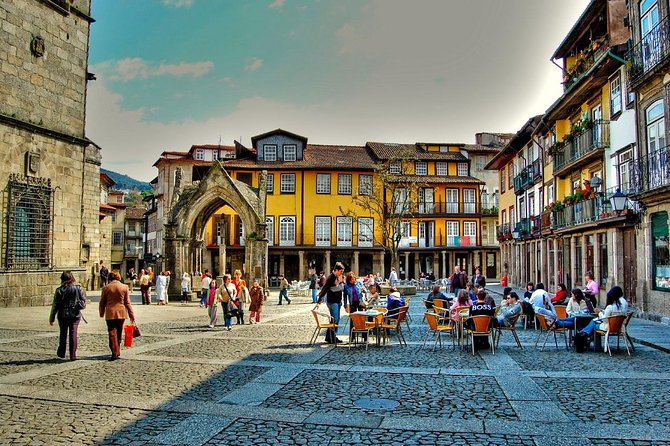
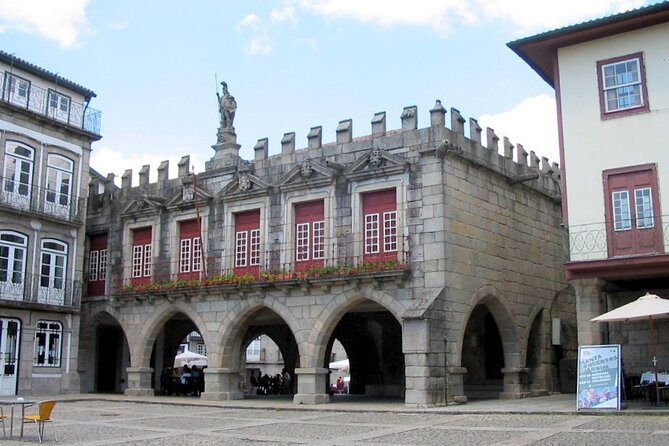
Right after the church comes Largo da Oliveira, about 10 minutes and free admission. This square is named after a centuries-old olive tree planted on the same site. You can see how the city’s identity is literally rooted in one symbolic element.
The square also includes a Gothic shrine built during the reign of D. Afonso IV to commemorate the Battle of Salado, when Portuguese and Castilian forces together defeated the Moorish army from Granada in 1340.
What makes this useful for your day is that it connects the spiritual center of Guimarães with a specific military-political event. Medieval cities were never just about religion or just about war. They were both, close together.
Montanha – Parque da Penha: tiles, caves, and big viewpoint energy
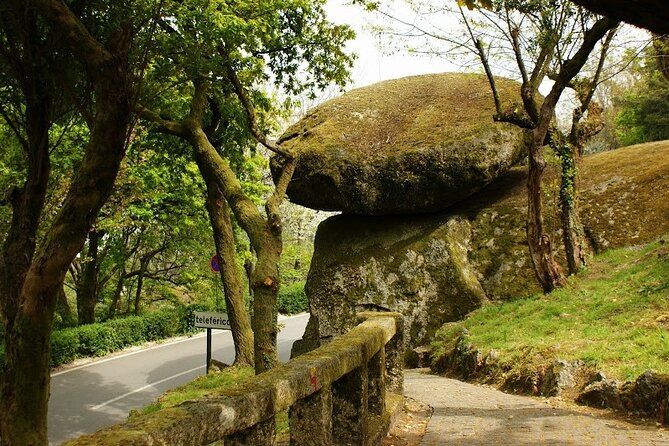
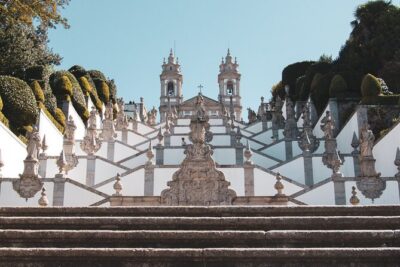
The final major stop is Montanha- Parque da Penha, about 1 hour with free admission. Here you visit the Sanctuary of Nossa Senhora da Penha, a well-known pilgrimage site.
The chapel was built in 1652 and served as a convent as early as 1727, tied to the Imaculada Conceição. In the sanctuary, you are meant to appreciate the stunning set of tiles and the pulpit. This is a change in tone from palace and church interiors, because it feels more like a place of worship plus a social pilgrimage stop.
Beyond the sanctuary, you can explore several caves and enjoy the viewpoints. The tour area also includes a campsite, mini golf, outdoor exercise area, equestrian center, picnic space, walking tracks, restaurants, bars, and coffee shops.
Two practical notes for you. One, this is the part that likely takes the most energy, so wear comfortable shoes. Two, the tour requires good weather, so if it is rainy or miserable up there, you will want to be glad you are doing it on a clear day.
What’s included, what’s not, and how to plan your day
Here is how this tour usually works from a “what you actually need” perspective:
Included:
- Pickup and drop-off from Porto
- Small group size, max 6
- Entrance to monuments (for multiple major stops)
- Local guide (Ricardo)
- Insurance, taxes and fees
- Photos of the tour
- Small hikes in natural or rural areas and in the city
- Visit of several monuments, up to 5
Not included:
- Lunch
- Tips
- Other expenses or activities not listed
For me, the biggest planning gap is lunch. Since it is a full day at around 9 hours, I would either eat before you go or plan a simple meal during your Penha time window if there is food available where you end up. Even a snack bag can save you from that late-afternoon crash.
Best for: history lovers who still like scenery and short walks
This tour is a strong fit if you want a one-day hit of medieval Guimarães without building the route yourself. The mix of castle, palace, major churches, and UNESCO historic core is exactly the kind of structure that helps first-time visitors.
It is also a good match if you like practical context. With a guide like Ricardo, the stories do not stay trapped in dates and names. They connect to why buildings were built, reused, ruined, then restored.
If you prefer only museums and long indoor pacing, the short time at each stop might feel tight. But if you like active sightseeing with breaks, this day works.
Should you book the Guimarães Medieval Tour?
I’d book it if you want:
- A small-group day trip with an actual guide and included monument access
- UNESCO historic core time, plus a final viewpoint stop on Penha mountain
- A plan that feels balanced between major “big story” sites and neighborhood streets
I would skip it if:
- You hate short stops and prefer to linger longer at one monument
- You really need lunch included in the price
- Your schedule only allows bad weather days, since the Penha portion depends on good conditions
If your ideal Porto day trip is medieval sites that feel coherent, not random, this one is easy to recommend. With the small size and Ricardo’s storytelling, you end the day understanding Guimarães as the cradle story it claims to be, then you get a view from Penha to let it all settle in.
FAQ
What is the duration of the Guimarães Medieval Tour?
It runs for about 9 hours.
Where does the tour start and end?
The tour starts and ends at R. de Guilherme da Costa Carvalho 38, 4000-065 Porto, Portugal.
What time does the tour begin?
The start time is 8:30 am.
How big is the group?
The maximum group size is 6 travelers.
Is pickup and drop-off included?
Yes, pickup and drop-off are included.
Are monument entrance fees included?
Admission tickets are included for several monuments, and some stops have free admission.
Does the tour include a mountain or nature element?
Yes, it includes small hikes and ends with a visit to Montanha- Parque da Penha.
Is lunch included?
No, lunch is not included.
Fresh off the Porto quays




Braga & Guimarães Day Trips, compared.
Best of Braga and Guimaraes Day Trip from Porto
Read our review →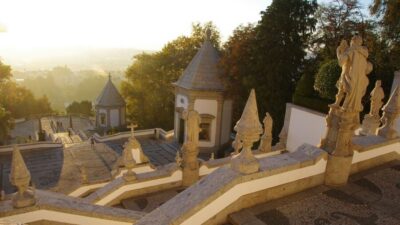
Guimarães & Braga Tour with Entry Tickets and Lunch
Read our review →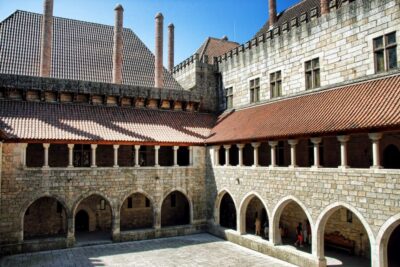
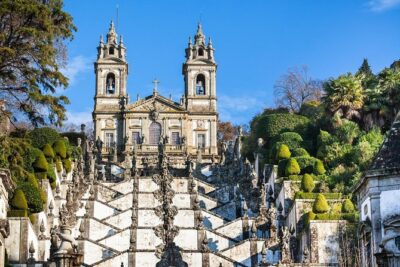
Braga & Guimarães Small Group Tour: Lunch & All Tickets Included
Read our review →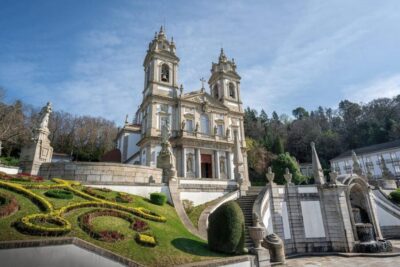
Guimaraes & Braga Small Group Tour with Lunch and Tickets
Read our review →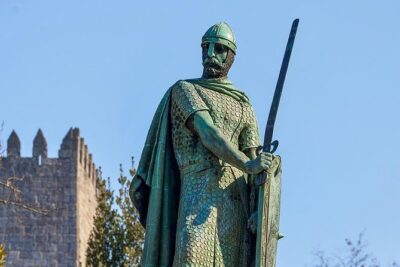
Browse the lists this tour appears in